

Would You Let Simon Run the Board?


Artificial intelligence is rapidly moving from a back-office tool to a seat at the boardroom table. While AI can analyse data faster and more consistently than humans, the real question isn't whether it can make critical decisions—it's whether we should let it make decisions that shape human lives.
The Future Is Already in the Building
If you watched the latest series of The Capture, you'll have met Simon—an artificial intelligence trusted to make decisions that once belonged entirely to humans. It decides who to follow, which risks are worth taking and, ultimately, whose lives matter most.
It makes for compelling television, but the question it raises has quietly moved from science fiction into today's boardrooms. How comfortable are we with machines making decisions that affect people?
Business psychologist Tomas Chamorro-Premuzic argues that many organisations are already moving in this direction. AI is evolving from a tool used to summarise reports and stress-test ideas into an active participant in strategic decision-making. In some AI-native organisations, it is already influencing executive decisions. The debate is no longer whether AI will have a seat at the table, but how much of that table should remain human.
Why the Case for AI Is So Strong
There is a compelling argument for inviting AI into the boardroom.
Human judgement is imperfect. We are influenced by confirmation bias, groupthink, affinity bias and emotion. Two leadership teams presented with identical information can reach completely different conclusions depending on circumstances as trivial as time pressure, fatigue or even whether lunch has been served.
AI doesn't suffer from those inconsistencies. It processes enormous volumes of information, applies the same logic every time and increasingly outperforms humans in areas such as pricing, hiring, capital allocation and risk modelling. When organisations turn to AI for support, they are often responding sensibly to well-understood human limitations rather than simply embracing new technology.
Why We Still Feel Uncomfortable
Despite AI's strengths, most people instinctively resist the idea of machines making morally significant decisions.
Research by psychologists Yochanan Bigman and Kurt Gray found that people consistently object to algorithms making decisions in areas such as healthcare, law and military operations—even when those decisions produce objectively better outcomes.
That finding matters. It suggests our discomfort is not rooted in a fear that machines will make poor decisions. Instead, we believe some decisions should belong to someone who has to carry responsibility for the outcome.
Correct Isn't Always the Same as Right
Imagine a board discussing redundancies.
An AI system could model the financial savings, forecast future scenarios and recommend the most efficient solution. From a data perspective, its answer might be entirely correct.
But leadership is rarely just about optimisation.
S
omeone still has to sit across from affected employees, explain the decision and live with its consequences. That emotional weight isn't a weakness that slows good decision-making—it's often what keeps difficult decisions ethical, balanced and humane.
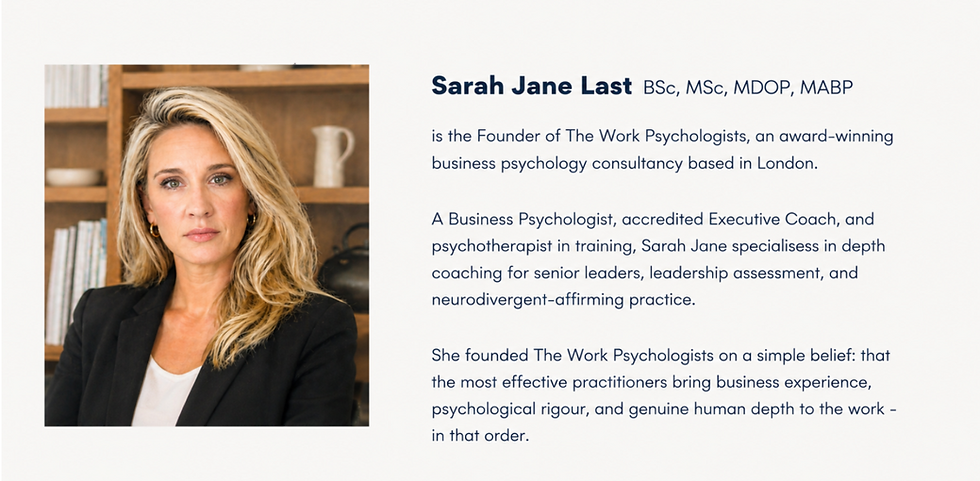
As Sarah-Jane argues, this is the distinction between a decision that is technically correct and one that is genuinely right.
The Two Biggest Risks
Ironically, organisations can make mistakes at both ends of the spectrum.
Some leaders fall into algorithm aversion, dismissing AI after a single mistake despite evidence that it remains more accurate than human judgement overall.
Others make the opposite mistake by delegating too much authority to systems they don't fully understand. Research suggests people express less moral outrage when harmful decisions are made by algorithms, making it easier for accountability to quietly disappear behind the phrase, "The system decided."
That may be the greatest danger of all—not that AI takes over the boardroom, but that human leaders gradually stop owning their decisions.
Keep a Hand on the Wheel
The answer is neither to reject AI nor surrender to it.
The strongest organisations will use AI to widen their thinking, challenge assumptions and test alternative scenarios. They will also ensure that human leaders remain responsible for judgement, ethics and accountability.
Research shows people are significantly more willing to trust AI when they retain some control over its recommendations. AI should enhance leadership—not replace it.
The Real Question Isn't About AI
Ultimately, this debate has very little to do with technology.
Leadership has always required people to balance logic with compassion, efficiency with ethics, and data with judgement. AI can help leaders make better-informed decisions, but it cannot experience responsibility, regret or conscience.
Those qualities remain uniquely human.
By all means invite AI into the room. Let it analyse, challenge and inform. But keep someone at the table who is willing to carry the consequences of the final decision.
Because the question was never really whether AI can make these decisions.
It's whether anyone should make them without having to feel their weight.
Sources
Bigman, Y. E., & Gray, K. (2018). People are averse to machines making moral decisions. Cognition, 181, 21-34. https://doi.org/10.1016/j.cognition.2018.08.003
Bigman, Y. E., Wilson, D., Arnestad, M. N., Waytz, A., & Gray, K. (2023). Algorithmic discrimination causes less moral outrage than human discrimination. Journal of Experimental Psychology: General, 152(1), 4-27. https://doi.org/10.1037/xge0001250
Chamorro-Premuzic, T. (2026, 8 June). How C-suite and board roles are being reshaped around AI. Harvard Business Review. https://hbr.org
Dietvorst, B. J., Simmons, J. P., & Massey, C. (2015). Algorithm aversion: People erroneously avoid algorithms after seeing them err. Journal of Experimental Psychology: General, 144(1), 114-126. https://marketing.wharton.upenn.edu/wp-content/uploads/2016/10/Dietvorst-Simmons-Massey-2014.pdf
Dietvorst, B. J., Simmons, J. P., & Massey, C. (2018). Overcoming algorithm aversion: People will use imperfect algorithms if they can (even slightly) modify them. Management Science, 64(3), 1155-1170. https://doi.org/10.1287/mnsc.2016.2643
Janis, I. L. (1982). Groupthink: Psychological studies of policy decisions and fiascoes (2nd ed.). Houghton Mifflin.
Singer, T., & Klimecki, O. M. (2014). Empathy and compassion. Current Biology, 24(18), R875-R878. https://doi.org/10.1016/j.cub.2014.06.054
Key Takeaways
AI is moving from a back-office tool to a strategic decision-maker, forcing organisations to rethink what leadership should remain uniquely human.
Human judgement is flawed, but AI introduces different risks. The goal isn't choosing one over the other—it's combining the strengths of both.
The greatest danger isn't artificial intelligence itself—it's leaders quietly outsourcing accountability.
Some decisions require more than logic. They require empathy, conscience and a willingness to live with the consequences.
The most effective future leaders will use AI to improve judgement, not replace it. Human accountability must remain at the centre of every important decision.


Comments