

How Do You Lead a Team That’s Exhausted by Change?

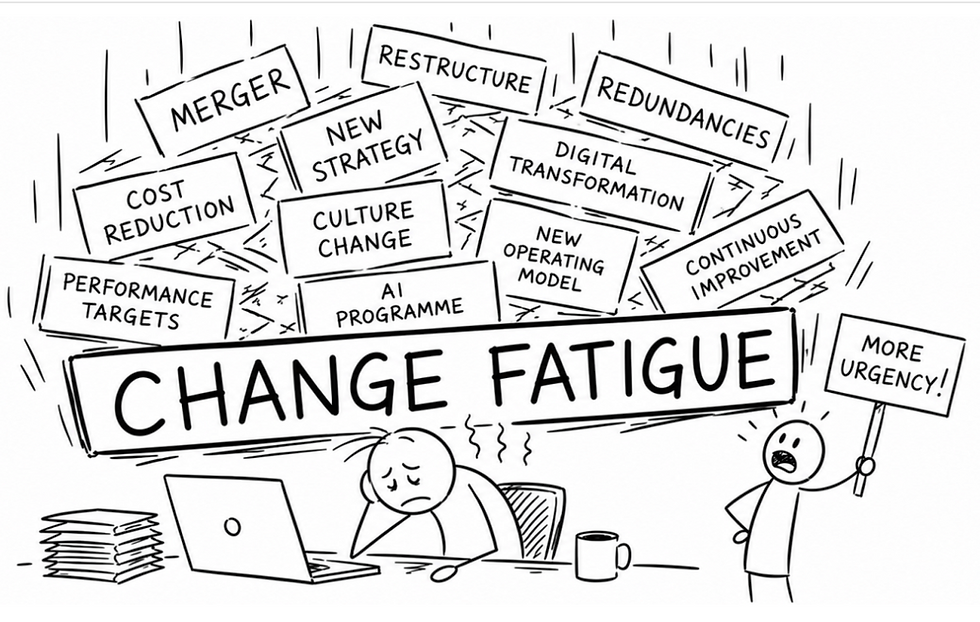
When a team is exhausted by change, the answer is not to push harder. Change fatigue is not resistance or a lack of motivation — it is depletion. Leaders cannot inspire people out of an empty tank; they must first help refill it.
Why Does Change Drain People So Completely?
Change becomes overwhelming when demands increase while control decreases. Research consistently shows that people cope far better with pressure when they feel they have some influence over how they work.
The Hidden Cost of Low Control
The landmark Whitehall II study found that employees with low control over their work faced significantly higher health risks, including heart disease.
When people lose control, they often experience:
Increased stress and anxiety
Reduced resilience
Lower engagement
Greater risk of burnout
Deteriorating physical wellbeing
Burnout Is the Result of Chronic Stress
The World Health Organisation recognises burnout as a workplace syndrome caused by unmanaged chronic stress. Emotional exhaustion sits at the centre of burnout, and repeated organisational change is one of the fastest ways to create it.
Why Mergers Make Fatigue Worse
Mergers create additional pressures that are often overlooked:
Ongoing uncertainty about roles, structures and future plans
Loss of familiar teams, rituals and ways of working
Grief for what has been left behind
Increased emotional energy spent anticipating bad news
This creates what psychologist Pauline Boss describes as ambiguous loss — a loss that is real but lacks closure or acknowledgement.
The Psychological Contract Gets Broken
Every employee carries an unspoken agreement about what they give and what they receive in return.
During mergers, restructures and redundancies, that agreement can feel broken, resulting in:
Reduced trust
Lower commitment
Declining job satisfaction
Reduced discretionary effort
Increased intention to leave
Research shows these outcomes occur consistently when employees perceive a breach of the psychological contract.
What Is Really Happening?
Leaders often assume they have a motivation problem.
In reality, they may have a team that is:
Running a prolonged stress response
Mourning losses that have never been acknowledged
Navigating uncertainty with little sense of control
Recovering from a breakdown in trust
A more compelling case for change will not solve any of these issues.
What Should Leaders Avoid Saying?
Many well-intentioned leaders respond with corporate optimism:
"This is an exciting new chapter."
"We need to embrace change."
"It's an opportunity to do more with less."
"Challenges are opportunities in disguise."
While intended to motivate, these statements can have the opposite effect. They ask exhausted people to display enthusiasm they do not genuinely feel. Over time, this damages credibility and trust.
Why Is Honesty So Important During Change?
Before people can move forward, they need leaders to acknowledge reality.
Tell the Truth First
Kim Scott's concept of Radical Candour highlights the importance of balancing care with honesty. The most effective leaders acknowledge difficult realities rather than hiding behind positivity.
When leaders openly recognise:
Low morale
Exhaustion
Uncertainty
Frustration
they often strengthen trust rather than weaken it.
People already know how they feel. Hearing it acknowledged allows them to stop pretending.
What Might Honest Leadership Sound Like?
Rather than delivering a scripted speech, leaders can communicate a few key messages.
Acknowledge Reality
Recognise that people are tired
Acknowledge the impact change has had
Avoid pretending stability is imminent
Commit to Transparency
Share information as early as possible
Reduce surprises
Address uncertainty directly
Reinforce What Remains Stable
Highlight what is not changing
Remind people why their work matters
Create a sense of continuity
Share Ownership
Involve the team in shaping how change is implemented
Invite feedback
Encourage people to raise concerns before problems escalate
These behaviours build trust because they close the gap between what employees experience and what leaders say.
Why Should Leaders Take Change Fatigue Seriously?
The greatest risk is not simply reduced morale.
Your Best People Are Often the First to Leave
Research into mergers and acquisitions shows that:
High performers are often the first to disengage
Employees with the strongest external opportunities leave earliest
Retention problems emerge before resignations become visible
This means that unchecked change fatigue can become a talent retention crisis.
How Can Leaders Restore Energy and Resilience?
Give People More Control
Even when major decisions cannot be changed, leaders can increase autonomy by:
Allowing teams to shape implementation plans
Giving people input into priorities
Letting teams decide what can be stopped to create capacity
Protecting areas where employees can exercise judgement
Small increases in autonomy can significantly reduce strain.
Build Recovery Into the System
Recovery is not a luxury; it is a requirement for sustainable performance.
Examples include:
Protected focus time
No-meeting periods
Downtime between major initiatives
Encouraging genuine disengagement from work outside working hours
Research shows that people who can properly recover return with greater energy, focus and resilience.
Protect What Stays the Same
During periods of uncertainty:
Maintain important rituals
Preserve key team routines
Reinforce organisational anchors
Stability in one area helps people cope with disruption in another.
Prioritise Ruthlessly
Not everything can happen at once.
Effective leaders:
Remove unnecessary work
Delay non-essential initiatives
Create space for people to adapt
Saying "no" is often as important as saying "yes".
Manage the Emotional Climate
Leadership behaviour influences team mood.
A calm and composed leader can:
Reduce anxiety
Improve confidence
Create psychological safety
A visibly anxious leader can unintentionally amplify uncertainty.
What Is the Real Goal of Leading Through Change?
The objective is not simply to survive the current round of change.
The goal is to build a team that can adapt repeatedly without becoming depleted. This requires developing:
Change resilience
Adaptability
Empathy
Follow-through
Sustainable capacity for future challenges
The organisations that thrive over the long term are not necessarily those that manage each individual change best. They are the ones that build people who can continue adapting, learning and performing through ongoing uncertainty.
References:
Karasek, R. A. (1979). Job demands, job decision latitude, and mental strain: implications for job redesign. Administrative Science Quarterly, 24(2), 285-308. https://doi.org/10.2307/2392498
Bosma, H., Marmot, M. G., Hemingway, H., Nicholson, A. C., Brunner, E., & Stansfeld, S. A. (1997). Low job control and risk of coronary heart disease in Whitehall II (prospective cohort) study. BMJ, 314(7080), 558-565. https://doi.org/10.1136/bmj.314.7080.558
World Health Organisation (2019). Burn-out an "occupational phenomenon": International Classification of Diseases. https://www.who.int/news/item/28-05-2019-burn-out-an-occupational-phenomenon-international-classification-of-diseases
Maslach, C., Schaufeli, W. B., & Leiter, M. P. (2001). Job burnout. Annual Review of Psychology, 52, 397-422. https://doi.org/10.1146/annurev.psych.52.1.397
Boss, P. (1999). Ambiguous Loss: Learning to Live with Unresolved Grief. Cambridge, MA: Harvard University Press. (Book, no DOI.)
Rousseau, D. M. (1989). Psychological and implied contracts in organizations. Employee Responsibilities and Rights Journal, 2(2), 121-139. https://doi.org/10.1007/BF01384942
Zhao, H., Wayne, S. J., Glibkowski, B. C., & Bravo, J. (2007). The impact of psychological contract breach on work-related outcomes: a meta-analysis. Personnel Psychology, 60(3), 647-680. https://doi.org/10.1111/j.1744-6570.2007.00087.x
Kim, J. D. Predictable Exodus: Startup Acquisitions and Employee Departures (covered by MIT Sloan, 2026). https://mitsloan.mit.edu/ideas-made-to-matter/your-acquired-hires-are-leaving-heres-why
Scott, K. (2017). Radical Candor: Be a Kick-Ass Boss Without Losing Your Humanity. New York: St. Martin's Press. https://www.radicalcandor.com/the-book/
Sonnentag, S., & Fritz, C. (2007). The Recovery Experience Questionnaire: development and validation of a measure for assessing recuperation and unwinding from work. Journal of Occupational Health Psychology, 12(3), 204-221. https://doi.org/10.1037/1076-8998.12.3.204
Key Takeaways
Change fatigue is not resistance — it is depletion. Teams struggling through continuous change need recovery and support, not more pressure and motivation.
The biggest driver of stress during change is the combination of high demands and low control. Giving people even small amounts of autonomy can significantly improve resilience.
Mergers create hidden emotional challenges, including uncertainty, grief for what has been lost, and a perceived breach of trust between employees and the organisation.
Leaders build trust by acknowledging reality rather than relying on corporate optimism. Honest, transparent communication is far more effective than forced positivity.
Sustainable change requires recovery as well as performance. Teams need time to recharge, clear priorities, and a sense of stability if they are to remain engaged and adaptable over the long term.

Comments