

For the first time, people are Googling "jobs that help people" more than "jobs that pay well." That is not the whole story.
- Sarah-Jane Last

- Jun 4
- 7 min read
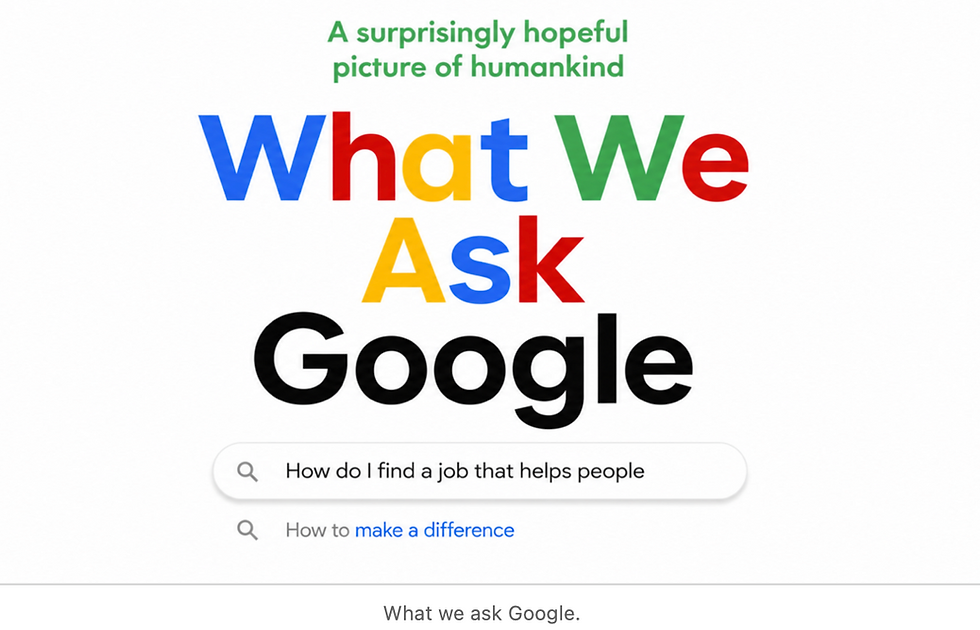
Here is a small thing that says a great deal.
Simon Rogers, a data editor at Google, shared something in CNBC this May. For years, one of the top career searches was "careers that pay well." Predictable. Sensible. Then a different search climbed fast and pushed its way near the top. Not money. Meaning. People typing some version of "a job that helps people."
It is a lovely finding. It is also worth a second look before we get carried away.
This is search data, not a survey. It tells us what people type into a box late at night when no one is watching. It does not tell us what they do on a Monday morning when a real offer with a real salary is in front of them. Searching "jobs that help people" is a wish. Taking the job is a decision. They are not the same thing.
And here is the part that should stop every leader in their tracks. What we wish for and what we settle for have pulled a long way apart. The space between them has a cost, and we can now put a number on it.
The wish is real
Start with the wish, because the data behind it is strong.
Deloitte runs the largest ongoing study of younger workers in the world. In its 2025 survey, 89% of Gen Z and 92% of millennials said a sense of purpose matters to their job satisfaction and wellbeing. That is not a fringe view. That is almost everyone.
And they act on it. 44% of Gen Z and 45% of millennials have left a role because it lacked purpose. Around 40% have turned down a project, an assignment, or an employer because it clashed with their values. People are not just searching for meaning. Some are walking away from money to find it.
So the wish is genuine. People want their work to count.
The settle is real too
Now the other half, which is just as true.
When you ask people what they actually prioritise heading into 2026, pay comes back to the top. Deloitte's own people describe it as a trifecta of money, meaning and wellbeing, and they are honest about what happens when the three cannot all be had at once. Many people pick the salary and the work-life balance, then go looking for meaning outside of work entirely. Deloitte also found that without financial security, people are less likely to feel their work is meaningful at all.
Read that last line twice. Money does not compete with meaning. Money clears the ground for it. A frightened person cannot hear a mission statement. They are thinking about rent, and they are right to.
So we have two true things sitting next to each other. What we search for leans towards purpose. What we accept leans towards pay. That is not a contradiction. That is the whole game.
What the gap costs
Here is where it gets expensive.
When people show up for the salary but never connect to the why, you do not get rebellion. You get something quieter and more costly. You get disengagement. People who are present but not really there.
Gallup measures this every year, across more than 140 countries, in the largest study of its kind. The 2026 figures are bleak. Global employee engagement fell to 20% in 2025, the lowest since the pandemic. That means four in five workers worldwide are not engaged.
The cost of that disengagement, in lost productivity, is an estimated 10 trillion US dollars. Roughly 9% of global GDP. Gone. Not to a competitor. Just left on the table by people who turned up and did the minimum.
And if you think that is someone else's problem, look at the UK. Only 10% of UK workers are engaged. One in ten. We sit near the bottom of the developed world on this measure, and the number has not moved in years.
This is what the gap looks like in practice. People wishing for meaning, settling for pay, and quietly checking out somewhere in between.
The manager is the hinge
There is one more number, and it changes where you point the effort.
Gallup finds that 70% of the variance in team engagement comes down to the manager. Not the brand. Not the perks. The person you report to. And manager engagement has fallen nine points since 2022. The people meant to carry purpose down through the organisation are themselves running on empty.
This matters because it tells you the work is not a poster campaign. It is a management problem. The manager is the hinge between what the company says it stands for and what the employee feels on a wet Tuesday. When the hinge is rusted, nothing the leadership team believes ever reaches the floor.
And here is a small thing we notice from the inside. There has been a boom in coaching at middle-management level. Some of it is wonderful, and it builds managers into better leaders. But a fair chunk of it is something else. It is companies who never trained their managers, quietly outsourcing the job. Can't have a difficult conversation with your team? Here is a coach. Can't give honest feedback? Here is a coach. The coach is doing the managing the manager was never taught to do.
That is not a coaching problem. It is a symptom. When an organisation buys coaching to plug a gap it should have closed years ago through proper development, it is treating the bill, not the illness. Good coaching grows a manager. Lazy coaching just rents one. The difference matters, and the leaders worth following can tell the two apart.
This is not a theory. It is already happening.
If this sounds like soft idealism, look at two British companies most people half-know already.
Start with Timpson, the high-street key cutter and shoe repairer. On paper it should be a tough, low-margin business. Instead it is one of the most quietly brilliant culture stories in the country, and it grew into a chain of well over 2,000 shops while staying family-owned. Two things make it work. First, what they call upside-down management. Head office is not allowed to issue orders. The people in the shops have full authority to do whatever they think is right for a customer, including handing out discounts or cleaning an unemployed person's interview outfit for free. Second, around one in ten of their staff are ex-offenders, hired for who they are now rather than what they did before. The result is fierce loyalty, low turnover and a workforce that gives a damn. The purpose and the commercial success are not in tension. One feeds the other. Their former boss, James Timpson, was so associated with this approach that the government made him prisons minister.
Then take Octopus Energy, which is barely ten years old. It started with a plain mission: use technology to make green energy affordable and treat customers like human beings. Energy is an industry people love to hate, yet Octopus built a TrustPilot score most brands can only dream of, racked up Which? recommendations year after year, and grew to more than 10 million customers worldwide. In late 2024 it overtook British Gas to become the UK's largest energy supplier, the first time that crown had changed hands since the 1990s. It is now valued in the billions. They did not win by being the cheapest. They won by being the one people trusted, built on a culture their own annual report describes as autonomy, empowerment and trust.
One is a 150-year-old cobbler. The other is a tech-driven upstart. Neither treats its people as a cost to be squeezed, and both are winning because of it, not in spite of it.
A fair word of caution, because the opposite trap is real. Purpose cannot be bolted on for show. Customers and staff smell it instantly, and stated values that the daily experience contradicts do more harm than no values at all. Neither company above bought a mission statement. They changed how the place actually works. That is the difference between purpose as strategy and purpose as decoration.
So what does a purpose-led organisation actually do
Not a values statement nobody can recite. Not a mission carved into the reception wall. Something far plainer.
Get the order right.
Pay is the floor. Fair pay takes fear off the table. It does not buy you engagement, but it stops money being the only thing people can think about. Skip this and everything that follows sounds like a trick. People have learned that purpose talk with no fair pay behind it is just a polite way of asking them to work for less. They do not fall for it any more.
Purpose is the ceiling. Once the floor is solid, this is where the energy lives. This is the reason someone gives you their best idea instead of their minimum effort. But it only gets heard once the money fear is quiet.
The manager is the load-bearing wall. This is where most organisations underinvest and it shows. If 70% of engagement runs through managers, then developing them is not a nice-to-have. It is the single highest-leverage move you can make.
Sort the pay. Take fear off the table. Back your managers properly. Then give people a reason worth turning up for. Get that right and you do not have to choose between heart and wallet. You get the whole person. That is the difference between people who work for you and people who are with you.
The one thing to take away
People wish for meaning but settle for pay. The gap between the two is quietly costing you your best work.
Close it in this order:
Pay fairly. Take fear off the table, so people can think about more than rent.
Give them a reason. A purpose they can feel, not a slogan on the wall.
Back your managers. They are the ones who join the two together, or fail to.
Miss any one of the three and you get bodies in seats. Get all three and you get people who are with you. And right now, with four in five workers checked out, that is the whole game.
A question worth sitting with: what would your team say if you asked them why the work matters? And would the pay make that a fair question to ask?
Sources:
Simon Rogers, Google, writing in CNBC (May 2026).
Deloitte 2025 Gen Z and Millennial Survey.
Gallup State of the Global Workplace 2026.
Timpson culture and ex-offender figures from Retail Week, Personnel Today and company reporting.
Octopus Energy growth, customer numbers and largest-supplier milestone from Marketing Week, company press releases and ICAEW.


Comments